
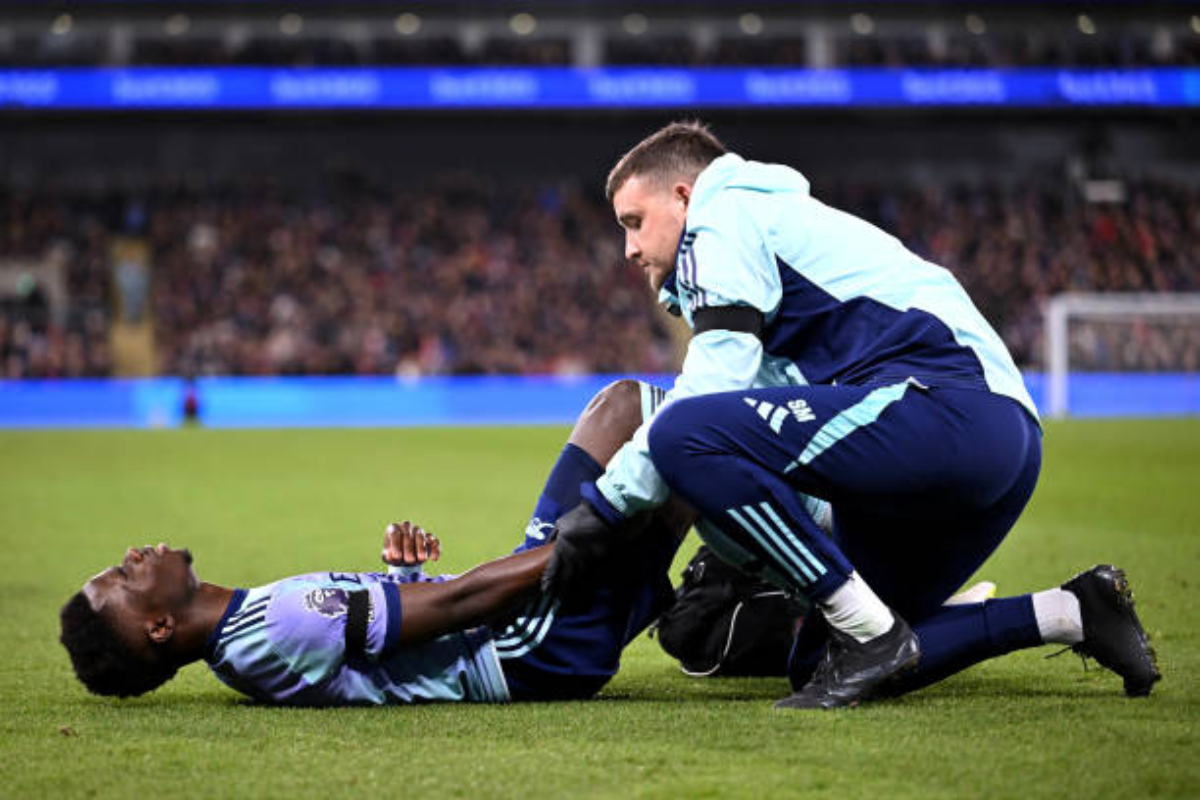
A Star Sidelined at the Worst Possible Time
When Bukayo Saka limped out of the picture during one of Arsenal’s most critical stretches of the season, the football world took notice. The 24-year-old winger is not just Arsenal’s best player — he is the heartbeat of the entire club. So when the Bukayo Saka injury news broke in late March 2026, fans, coaches, and analysts all had the same question: how bad is it, and when does he come back?
This article covers everything — the nature of the injury, the timeline, the recovery process, and what his absence and eventual return means for Arsenal’s Premier League title race, Champions League ambitions, and England’s World Cup squad.
What Happened to Bukayo Saka?
Saka featured in 42 of Arsenal’s first 50 matches of the season, up to and including the Carabao Cup final defeat to Manchester City on 22 March 2026. It was around that period that problems with his Achilles tendon began to surface.
When he withdrew from Thomas Tuchel’s England squad at St George’s Park, there was initial suspicion that Arsenal were simply shielding him from international duty. However, a continued absence from five consecutive matchday squads quickly underlined the seriousness of the issue.
Mikel Arteta later confirmed that the Achilles injury had begun to hamper Saka’s performances even before Arsenal took the formal decision to sideline him, choosing to focus on getting him back to his best for the final stretch of the season.
This was not a one-game knock. It was a situation that had been building, and Arsenal made the calculated decision to deal with it properly rather than risk making it worse.
How Serious Is the Injury?
Achilles injuries are particularly dangerous, and Arteta confirmed that Arsenal were erring on the side of caution with Saka’s recovery, especially given the expectation that the winger will feature for England at the 2026 World Cup.
The Achilles tendon is notoriously slow to heal and unforgiving when rushed. Even a partial strain or tendinopathy — rather than a full rupture — can linger and worsen under the strain of high-intensity football. Arteta was measured in his public comments: “Bukayo is out, that’s for sure. He’s just starting to do some stuff, so let’s see that progression, how quickly we can go through it, and then wait, but at the moment it’s not about that.”
That kind of careful language from a manager signals genuine concern. Arsenal were not going to rush their most important player back before his body was ready.
Arsenal’s Response and Arteta’s Statements
Throughout the injury period, Arteta maintained a consistent message: progress was being made, but caution was paramount.
Arteta did acknowledge midweek that there had been progression, and expressed hope that Saka would be back in “days not weeks.” That statement gave Arsenal fans real reason for optimism, even as the club confirmed he would miss the crucial Premier League clash away at Manchester City.
“Bukayo is out for sure,” Arteta said ahead of the Manchester City fixture, with the Gunners in the middle of a run that had seen them lose three consecutive domestic games, exit both cup competitions, and allow City to close the gap in the title race.
Arteta also had to manage the situation around Saka’s backup. Natural replacement Noni Madueke was himself an injury doubt for the City clash, meaning 16-year-old Max Dowman was potentially in line to start on the right wing — with Arteta expressing confidence that the teenager would “be ready.”
The Impact on Arsenal’s Season
The timing of the Bukayo Saka injury could hardly have been worse for Arsenal. Saka’s absence was described as a gut punch for Arsenal’s hopes of claiming their first Premier League title in 22 years, particularly given the team’s attacking struggles during his time out.
Without Saka, Arsenal looked blunted. His ability to beat defenders, draw fouls, create chances, and score goals in big moments is irreplaceable in the short term. The team lost rhythm and confidence, and the title race tightened as a result.
Arsenal needed to win every remaining Premier League match just to keep their fate in their own hands, knowing that even five wins from five might not be enough if Manchester City won six from six and held a better goal difference.
The Champions League offered some relief. Arsenal progressed to the semi-finals, where they faced Atletico Madrid — and the hope was to have Saka available for that first leg in Spain, with his return potentially coinciding with that fixture.
Saka’s Recovery Timeline
Here is a clear breakdown of key dates in the Bukayo Saka injury timeline:
- 22 March 2026 — Saka plays his last match before the injury layoff, featuring in the Carabao Cup final against Manchester City.
- Late March 2026 — Saka withdraws from the England squad, raising the first public flags about his fitness.
- Mid-April 2026 — Arteta confirms Saka is out and “just starting to do some stuff” in terms of on-pitch work.
- Late April 2026 — Reports indicate Arsenal are hopeful of a return within a week, with the Newcastle United and Atletico Madrid matches on the horizon.
- Early May 2026 — Arteta confirms Saka is fit and available again, with the winger having completed his recovery ahead of Arsenal’s match against Fulham. Arteta said: “Bukayo is ready to go. All the careful things he’s already done, so now it’s about putting him on the grass in the right moments.”
Arteta also noted that despite the three-month layoff from injury earlier in the season, Saka had played in the previous 48 months before that, adding: “Three in 48 is a very small percentage.”
His Return to Action
When Saka did return, the effect was immediate. After contributing a goal and an assist against Fulham, the 24-year-old then scored the winner against Atletico Madrid that sent Arsenal into the Champions League final.
His partnership with right-back Ben White was central to his sharp return to form. White’s nine passes to Saka against Fulham was the highest total by any player in that game, and the pair continued in the same vein in the Atletico fixture, with White again making more passes to Saka than anyone else on the pitch.
That combination of familiarity, trust, and sharp movement helped Saka hit the ground running after weeks on the sidelines — exactly what Arsenal needed in the defining weeks of the season.
What This Means for England and the 2026 World Cup?
The World Cup looms large over this entire situation. Arsenal were managing Saka’s recovery carefully with one eye on the 2026 World Cup, where he is expected to be a key figure for England.
Saka has established himself as one of England’s most important attackers since his breakthrough at Euro 2020. Losing him — even temporarily — would represent a significant blow to England’s chances in a tournament on home soil. The fact that Arsenal chose to rest him rather than risk a more serious setback speaks to the long-term thinking involved.
With his return to form now confirmed, Saka appears to be on track to head into the summer in excellent shape, both physically and in terms of confidence.
Saka’s Injury History: A Pattern of Concern
This is not an isolated incident. Injuries have plagued Saka over the past two seasons, and the England international had already missed over 30 games through fitness issues since the start of 2025 alone.
Earlier in the 2025-26 season, Saka tore his hamstring at Crystal Palace just before Christmas, which required surgery and kept him out for over three months before his return against Fulham in March. He had barely returned from that layoff before the Achilles issue sidelined him again.
In another instance earlier in the season, Saka suffered an injury during the warm-up to Arsenal’s 4-0 victory over Leeds United, with Arteta saying: “It doesn’t look like something too serious. Whether he’s going to be available for tomorrow or the weekend, we’ll see.”
The recurring nature of these setbacks raises genuine questions about workload management, recovery protocols, and whether Arsenal can afford to keep relying so heavily on one player. The club will need to find a more sustainable way to use Saka across a congested fixture schedule, particularly if they continue competing on all fronts.
Conclusion: The Cost of Brilliance and the Road Ahead
The Bukayo Saka injury story in 2026 is ultimately about the fine line elite players walk between peak performance and physical breakdown. Saka has been asked to carry Arsenal for large parts of the past two seasons, and the cumulative strain has shown.
But the story has a positive ending — at least for now. His return to form, capped by a Champions League semi-final winner, is a reminder of just how special he is when fit. For Arsenal’s title hopes and Champions League dreams, and for England’s World Cup ambitions, keeping Saka healthy between now and the summer is the single most important task on the agenda.
FAQs
What injury does Bukayo Saka have?
Saka has been dealing with an Achilles tendon injury that first became apparent around the time of the Carabao Cup final in March 2026. The injury had been affecting his performances before Arsenal officially sidelined him to manage his recovery properly.
How long will Bukayo Saka be out?
Saka missed approximately six weeks of action following the Carabao Cup final. By early May 2026, he had returned to full fitness and featured for Arsenal against Fulham and in the Champions League semi-final against Atletico Madrid.
Did Bukayo Saka need surgery?
There is no confirmed report that Saka required surgery for his Achilles issue in 2026. Earlier in the same season, however, he did undergo surgery after tearing his hamstring at Crystal Palace in December 2025.
Will Saka be fit for the 2026 World Cup?
All indications point to yes. Arsenal managed his recovery carefully with the World Cup in mind, and his strong performances upon returning — including a Champions League semi-final winning goal — suggest he will head into the summer in excellent condition.
How many games has Saka missed through injury?
Since the start of 2025, Saka has missed over 30 matches through various injury issues, making him one of the more injury-affected top players in the Premier League over that period despite his consistently high level when fit.
