
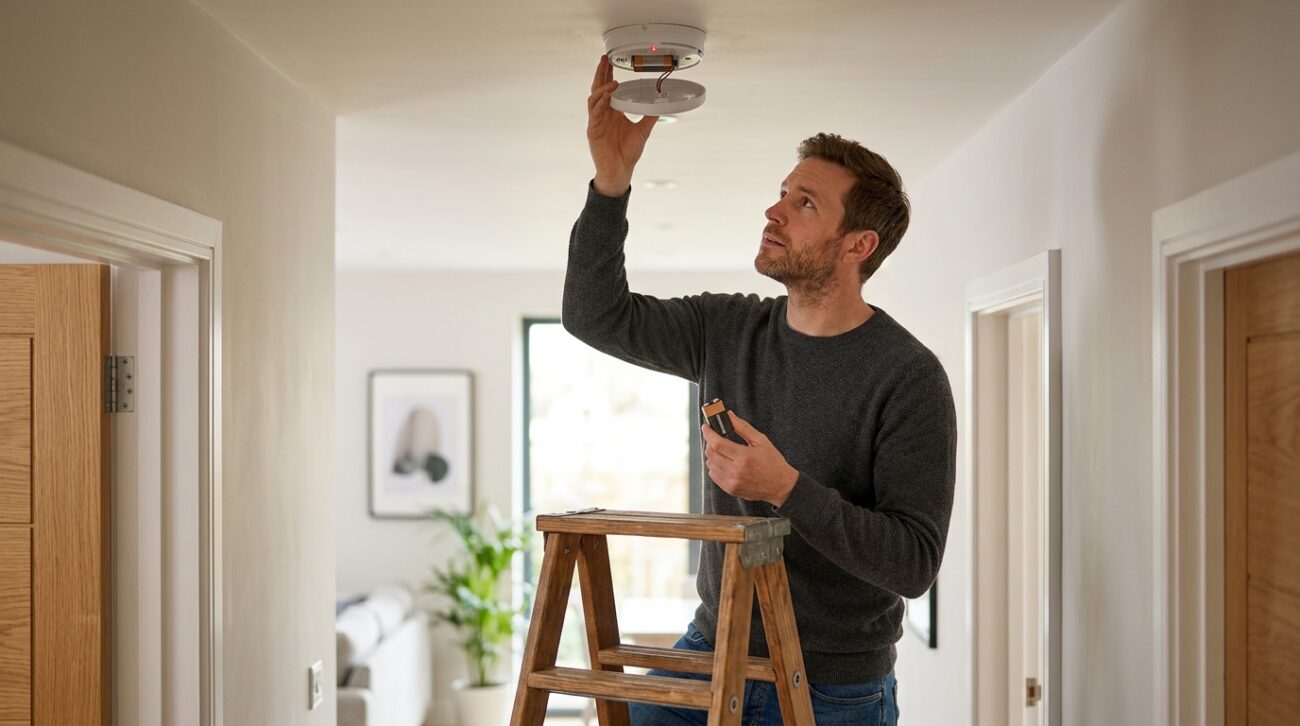
That relentless chirp from a smoke alarm is one of the most annoying sounds in any home — and also one of the most important. Most people either yank the battery out in frustration or ignore it entirely. Both responses can be dangerous.
A smoke alarm beeping is never random. Every chirp, every pattern, and every frequency carries a specific meaning. Understanding what your detector is telling you takes less than five minutes — and could genuinely save your life.
This guide covers every reason a smoke alarm beeps, how to silence it correctly, and how to know when the sound signals something you cannot afford to ignore.
Why Is My Smoke Alarm Beeping?
Smoke alarms communicate through sound. A continuous, full-volume alarm means detected smoke or fire. But the beeping most people complain about — that quiet, repetitive chirp every 30 to 60 seconds — is a status signal, not an emergency alert.
Here are the main reasons your smoke alarm is beeping:
- Low or dying battery
- End-of-life detector alert
- Residual charge after battery removal
- Steam, cooking smoke, or dust particles
- Extreme temperature or high humidity
- Faulty or incompatible battery installation
- Wiring issue in hardwired units
Each cause has a distinct fix. Knowing which one applies to your situation saves you time and avoids unnecessary alarm replacement.
Low Battery: The Most Common Cause
If your smoke alarm chirps once every 30 to 60 seconds, a low battery is almost certainly responsible. This is by far the most frequent reason detectors beep in the middle of the night — and yes, it almost always happens at 2 AM. That is not coincidence. Battery performance drops in cooler temperatures, and nights are cooler, so the alarm registers a voltage dip it would not notice during warmer daytime hours.
The fix is straightforward. Replace the battery with a fresh one — ideally a high-quality alkaline or lithium 9V. After replacement, press and hold the test button for a few seconds to reset the unit. The chirping should stop immediately.
A few important points:
- Do not use rechargeable batteries in most smoke alarms — they deliver inconsistent voltage.
- Some modern detectors use sealed 10-year lithium batteries that cannot be replaced. If yours is one of these and it is chirping, the unit itself needs replacing.
- If chirping continues after a new battery, the issue lies elsewhere.
End-of-Life Chirping — Your Detector Is Expiring
Smoke alarms do not last forever. Most manufacturers build a lifespan of 8 to 10 years into their units. When a detector approaches the end of its functional life, it begins chirping in a pattern that often gets mistaken for a low-battery warning.
Check the back or inside of your detector for a manufacture date. If it is more than 10 years old, stop troubleshooting and replace it entirely. No amount of battery swapping will fix an expired unit, and a failing smoke alarm provides false security — it may not detect actual smoke reliably.
This is one of the most overlooked causes of persistent smoke alarm beeping. Many homeowners replace batteries three or four times before realizing the unit itself is the problem.
Smoke, Steam, or Dust Triggering the Alarm
Sometimes the beeping escalates into a full alarm, not a chirp. If this happens without any visible fire, consider these environmental triggers:
- Cooking smoke or grease from a stove or oven
- Steam from a hot shower, boiling water, or a humidifier placed too close
- Dust buildup inside the detector chamber (especially in older units or dusty homes)
- Aerosol sprays like hairspray, paint, or cleaning products used nearby
Ionization-type smoke detectors are particularly sensitive to cooking particles. Photoelectric detectors handle kitchen environments better. If your kitchen alarm triggers repeatedly during normal cooking, relocating it or switching detector types may be the right long-term solution.
To clean a dusty detector, remove it from the ceiling, open the cover if possible, and gently blow out the interior with compressed air. Never spray liquid cleaners inside a smoke alarm.
Temperature Extremes and Humidity
Smoke alarms are calibrated for typical indoor environments. When temperature or humidity falls outside that range, false alarms and random beeping become more likely.
High humidity — from a bathroom without adequate ventilation, a basement during wet seasons, or a laundry room — can cause water vapor to enter the sensing chamber and trigger beeping. Garages are particularly prone to this because they experience wide temperature swings and often contain vehicle exhaust fumes that can confuse ionization sensors.
If your alarm is located in a high-humidity area, relocating it a few feet away from the moisture source usually resolves the problem. Installing an exhaust fan nearby also helps.
How to Stop a Smoke Alarm From Beeping?
Follow these steps in order to silence a beeping smoke alarm correctly:
- Identify the beep pattern. One chirp every 30-60 seconds usually means low battery. Rapid beeping in bursts of three means the alarm is detecting something. Continuous chirping with no pattern after battery replacement often signals end-of-life.
- Replace the battery. Use a fresh alkaline or lithium 9V. Hold the test button for 15-20 seconds after installation.
- Check the manufacture date. If the unit is over 10 years old, replace it entirely.
- Inspect for environmental causes. Check for steam, smoke, or dust near the detector.
- Reset the alarm. For hardwired units, turn off the circuit breaker for the alarm, remove the backup battery, press and hold the test button for 15 seconds to drain residual charge, then restore power and reinstall the battery.
- Clean the detector. Use compressed air to remove dust from the sensing chamber.
- Replace the unit if none of the above resolves the issue.
Do not disconnect a smoke alarm permanently as a “solution.” The silence is not worth the risk.
Hardwired vs. Battery-Operated Alarms — What’s Different?
Battery-operated alarms are simpler to troubleshoot — the battery is usually the answer. Hardwired smoke alarms are more complex because they draw power from your home’s electrical system and use a battery only as a backup.
If a hardwired alarm is chirping, the backup battery may still be the culprit. But chirping can also indicate:
- A wiring fault or interrupted power supply
- A tripped breaker on the alarm’s circuit
- A communication issue between interconnected alarms (if one unit fails, others in the chain may chirp)
For interconnected hardwired systems, identifying which specific unit is the “source” alarm can be tricky. Many systems allow you to press the test button on each unit — the source alarm will beep back louder or differently than the others relaying the signal.
If you suspect a wiring issue, a licensed electrician is the appropriate next step. Do not attempt to rewire a hardwired smoke alarm yourself unless you have electrical training.
When Beeping Means Something Serious?
Most beeping is a maintenance signal — annoying but not urgent. However, certain patterns demand immediate attention:
- Three beeps, pause, repeat: This is the standard fire alarm pattern. Evacuate first, investigate second.
- Four beeps, pause, repeat: On combination smoke and carbon monoxide detectors, this pattern typically signals carbon monoxide detection. Leave the building immediately and call emergency services.
- Rapid continuous beeping: Active emergency. Do not pause to investigate.
If your alarm activates and you cannot identify a clear source of smoke or gas, treat it as real. The cost of a false evacuation is nothing compared to the alternative.
How Often Should You Replace a Smoke Alarm?
The National Fire Protection Association (NFPA) recommends replacing smoke alarms every 10 years from the manufacture date — not the purchase date. [EXTERNAL LINK: NFPA.org smoke alarm guidelines]
Beyond the 10-year rule:
- Replace immediately if the unit does not respond to the test button
- Replace after any alarm that involved actual fire, even minor
- Replace if the casing is yellowed, cracked, or visibly deteriorated
- Replace if it has been painted over (paint clogs the sensing chamber)
Most experts also recommend testing smoke alarms monthly using the test button and replacing batteries annually — or when the low-battery chirp appears, whichever comes first.
Conclusion
A smoke alarm beeping is not just a nuisance — it is your detector doing its job, telling you something needs attention. Whether it is a dying battery, an aging unit, environmental interference, or an actual emergency signal, every chirp has a meaning worth understanding.
The fix is usually simple: replace the battery, reset the unit, or replace the detector entirely if it has passed its service life. What you should never do is silence it permanently and move on.
Take five minutes today to check every smoke alarm in your home — test the button, check the manufacture date, and replace any unit that is overdue. It is one of the simplest, cheapest, and most effective things you can do to protect your household.
FAQs
Why does my smoke alarm keep beeping even after I replace the battery?
If chirping continues after a fresh battery, the unit may have residual charge stored in its capacitor. Remove the battery, press and hold the test button for 15-20 seconds to fully drain it, then reinstall the new battery. If chirping persists, the alarm has likely reached end-of-life and needs replacement.
Why does my smoke alarm beep in the middle of the night?
Night temperatures drop, which lowers battery performance temporarily. The alarm detects the voltage dip and registers it as a low-battery condition. This is the most common reason smoke alarms chirp between midnight and 5 AM. Replacing the battery resolves it.
How do I know if my smoke alarm is beeping because of carbon monoxide?
Combination smoke and CO detectors use distinct alarm patterns. Carbon monoxide alerts typically sound as four beeps, a pause, then four more beeps — repeated continuously. Smoke fire alerts are usually three beeps in a pattern. Check your specific model’s manual for exact codes, as patterns can vary by brand.
Is it safe to remove the battery to stop the beeping?
Only as a very short-term measure while you get a replacement battery — and only if there is no actual smoke or fire risk. Leaving a smoke alarm without a battery, even briefly, removes your early warning protection. Never remove the battery as a permanent fix.
How long does a smoke alarm last before it needs to be replaced?
Most smoke alarms have a functional lifespan of 8 to 10 years. After that, the internal sensors degrade and become less reliable, even if the unit still chirps or activates. Always check the manufacture date printed on the back of the unit and replace it once it reaches the 10-year mark.
